

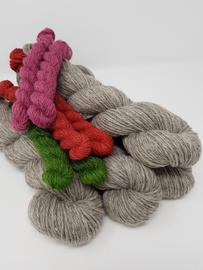
Our yarn kits contain the required amount of yarn needed to complete the project in a particular size.
Recently added




£8.25£10.99
Diary of a Provincial Lady by E M Delafield by Persephone books, was the inspiration and part of my Knitting Salon Book and Yarn club in 2024.
This great classic of domestic literature initially appeared in weekly instalments in Time and Tide, the feminist weekly. Some might find it an oxymoron that a book is both domestic and feminist. But this is the central remit of Persephone Books and the reason why Diary of a Provincial Lady (1930) is a quintessential title for us; and why, although there are other editions in print (EM Delafield is now out of copyright) we felt we wanted it to join our list. An additional reason was that we knew our German printer, GGP, would make an excellent job out of reproducing Arthur Watts’s original illustrations. Most previous editions have ignored these, however we feel they are a crucial part of the fun.
For the Diary, which chronicles the day-to-day life of a wife and mother living in the country, is above all fun, in fact it is one of the funniest books ever written. And yet the humour is of a particular, Mr Pooter-ish type: an earlier EM Delafield novel had on its frontispiece a quote from The Diary of a Nobody: ‘I left the room with silent dignity, but caught my foot in the mat.’ We recommend it to any Persephone reader who loved, for example, Nancy Mitford's The Pursuit of Love because, as the Afterword to the Diary observes: ‘Self-deprecation of this kind is a particularly English occupation, one which foreigners find rather hard to understand. From Emma through Cranford, to The Diary of a Nobody, EF Benson’s Lucia books, 1066 and All That and Mrs Miniver, to name but a few of the links in the chain, they are all books in which the English laugh at their own peculiarities. They are also books which make light of the potentially grave and which subtly transform tragedy into pathos and pathos into humour.’ Which is why the trivial (bulbs) is so often bracketed with the serious (the war) as in the opening entry: ‘November 7th 1929 Lady B stays to tea. We talk some more about bulbs, the Dutch School of Painting, Our Vicar’s Wife, sciatica, and All Quiet on the Western Front.’
You may also like